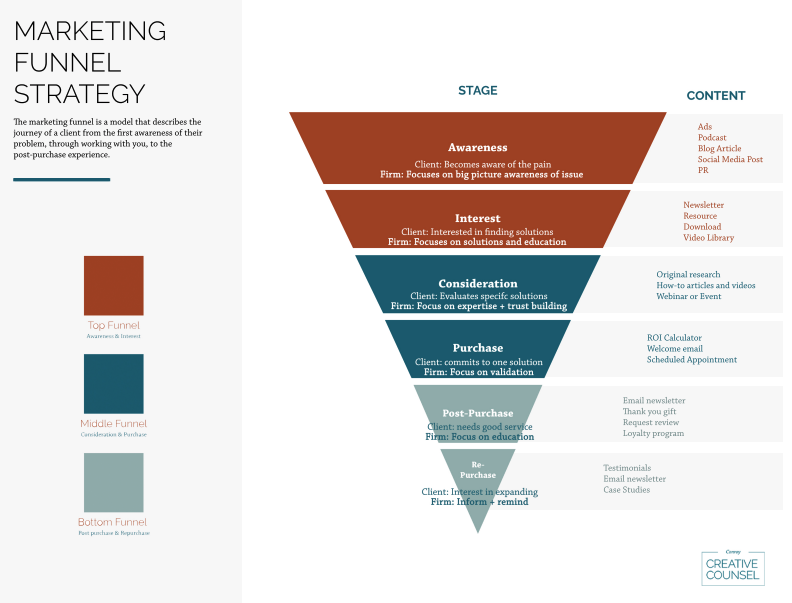

Digital marketing can be overwhelming when just getting started. Everything you do on your website plays an important role in converting your visitors to real life clients. Your conversion rate on your website is one of the more important metrics in your digital marketing and it isn’t just about sales. Conversion rates are desired actions that bring your firm closer to making a client by making appointments, request quotes, fill out contact forms, or reach out to you through phone or email.
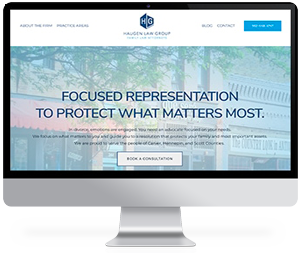
There are a few design elements that can help your website function better to boost conversions. Website designs can really determine if your visitors decide to stay on your page and learn about what services you have to offer. Some key website design elements are:
- Clear navigation
- Content layout
- Strong branding
- Intentional palettes
- White space usage
- Responsive design and mobile adaptability
By using clear and functional website designs paired with smart digital marketing optimization for search engines, you can boost your conversion rates. When you notice your website has heavy traffic, but you aren’t seeing the clients to back it up, you may want to develop a marketing strategy to achieve a higher conversion rate.
Here are our top seven tips to help your law firm improve your conversions.
7 Tips to Help Your Website Conversion Rate
Below are some examples to use as inspiration for your conversion marketing plan:
-
Use Social Proof
Social proof in marketing has been a tried and tested way to add a trust factor to your website. This can be an effective strategy as most people are more likely to engage when others are doing it as well. Consider adding testimonials from other clients, different case studies, and recommendations on your site to give credibility that others have used your services and support you and your team.
-
Offer Live Chat
If you have a first time visitor on your website, they may need specific or urgent questions they need an answer to. This answer being swiftly answered or not can be a deciding factor in if they choose to use your services or not. Live chat can not only help improve your conversion rate, but also offers instant client service, and client retention.
-
Use Website Analytics and Software
You can gain valuable insight on how your visitors navigate your site when using website analytics, by seeing what pages they view, how much time they spend on a page, and which traffic sources they came from. By studying your visitor’s demographics you can effectively strategize on what you need to improve based on the different types of visitors who are visiting your site.
-
Improve Your Page Speed
For you to deliver the best user experience, it’s crucial to have your website running as fast as possible. Each page load should load within 2 seconds, ideally under just 1 second. Without a fast loading page, your visitors are much more prone to bouncing off your page and looking for another page that gets them the information faster. You can test your page speeds with different online tools, and depending on your audience’s location, you can even test how fast your visitors access your site from that specific area.
Google Analytics provides its own speed analysis with the page timings reports, and can compare load times to the exit or bounce rates.
-
Have a Functional and Aesthetic Mobile Site
About 58% of visitors are using a mobile device when visiting your website. Make sure that your mobile website looks and runs well to provide a better experience for future clients. An unresponsive or difficult to use website will quickly turn away visitors, so create an aesthetically pleasing theme and easy to navigate layout to keep visitors on your site longer and convert them to a client.
-
Use A/B Testing
A/B testing is also called ‘split testing’, which is a marketing experiment where you split your audience to test different variations of campaigns to see which one performs better. You can show your ‘A’ audience one type of your marketing content, and ‘B’ sees another version. This can be valuable information to see how your audiences behave differently, and if one version works better than the other. You can split test things like variations of a headline, image, website copy, and more.
-
Remove Friction
Always remember to test your website to see how your viewer and potential client may see it. Getting an idea of what their perspective is can highlight any points of friction or areas that don’t make sense when you read it in a different way. It can be beneficial to read things on your page out loud and remove and change any issues you come across.
Increase Your Law Firm’s Website Conversion Rates
At Conroy Creative Counsel, we help you create the best law firm website available by offering impactful designs and guiding you on how to strategize effectively and make the most out of your digital presence. With our deep understanding of effective marketing strategies and attention to details, we can help clients reach professionals like yourself. Contact us today for a competitive advantage for you to stand out from the rest.